

Día de Muertos
Postcards from Mexico

Hello, Friends and Familia,
I’ve just returned from a two week trip to Mexico - or shall I call it a pilgrimage, as it was indeed for me. I have roots in Mexico, and grandparents who spoke a little Spanish to me when I was small, teaching me words like “ojo,” “barriga,” and “Vamos.” When I listened to extended family converse in Spanish and Spanish/English, I heard my grandmother and great-aunt speak about “la bruja” who lived near my great-aunt.
I have attempted to learn Spanish on and off since high school, with more attention to this goal in recent years. During the trip, my ability to speak - not that great to begin with - started out well enough, but deteriorated overtime (mental overload, I think).
That said, my ability to follow conversation improved (though there were also plenty of times when it lapsed. Again, probably due to overload). I took solace in the fact that I could read and comprehend far more than I could hear or speak. I’m motivated to close that gap!
I traveled with two friends, Cynthia and Erin, and we stayed with Cynthia’s family in Mexico City. Such hospitality and kindness! And I learned the truth again, that there is nothing like being welcomed into a home to begin to glimpse and understand (even in the tiniest of ways) the culture, people and place around you.
I hope to share more of the journey in The Book of Deer, but today, I’ll start with the illustrations I did while in Mexico.
These are painted with a travel palette of Daniel Smith watercolors, a water brush pen (just put water in the handle of the pen and you’re ready to paint!), and a Sakura Pigma Micron pen in a Moleskine watercolor notebook.
Enjoy these little “postcards”!
Desierto de los Leones Monastery, Cuidad de Mexico
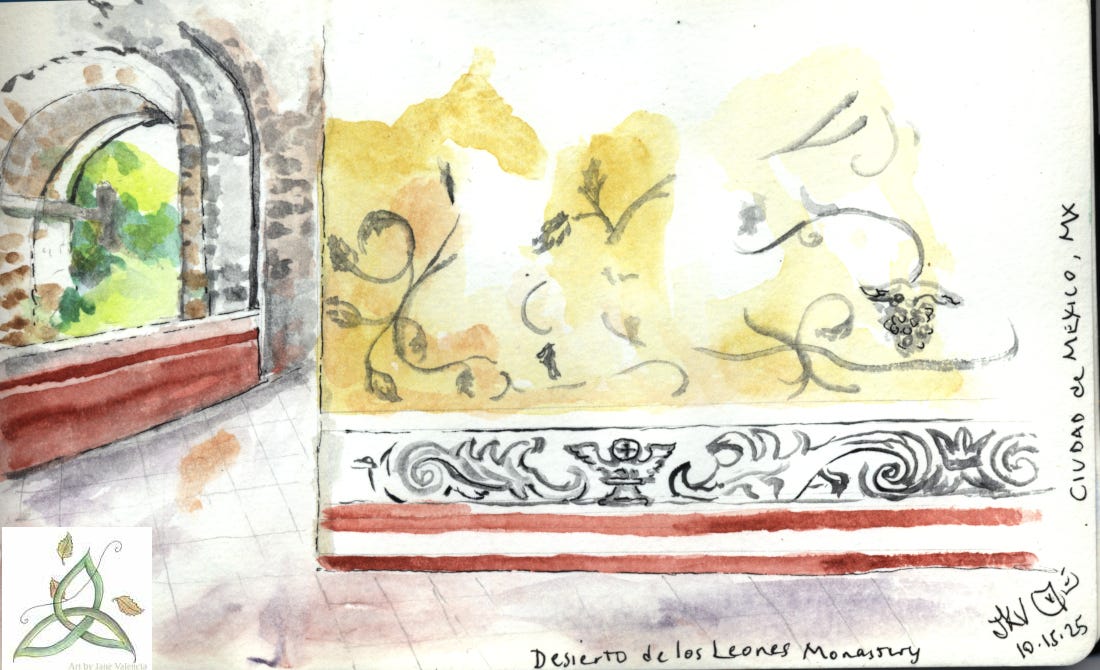
Our first full day we adjusted to the altitude (7,500 ft or so vs. the sea level we left behind) and got our bearings. We went a little into the mountains to Desierto de los Leones, a Carmelite monastery established in the 17th century, which is now surrounded by a large, national park. The monastery is a cultural site, and no longer active as a monastery as such. We did however meet up with three different quinceañera parties doing photo shoots. The 15-year-old young women being photographed wore fancy sparkly ball gowns and crowns too if I remember correctly, and resembled fairies (minus wings) in the way they at times moved through the gardens and cloister.
Other times, they revealed themselves to be very much who they were, teen girls! One wore sneakers under her ball gown. Another accompanied her photo shoot with some loud music. A bouquet of fancy helium balloon were another girl’s prop.
Pericón in Malinalco
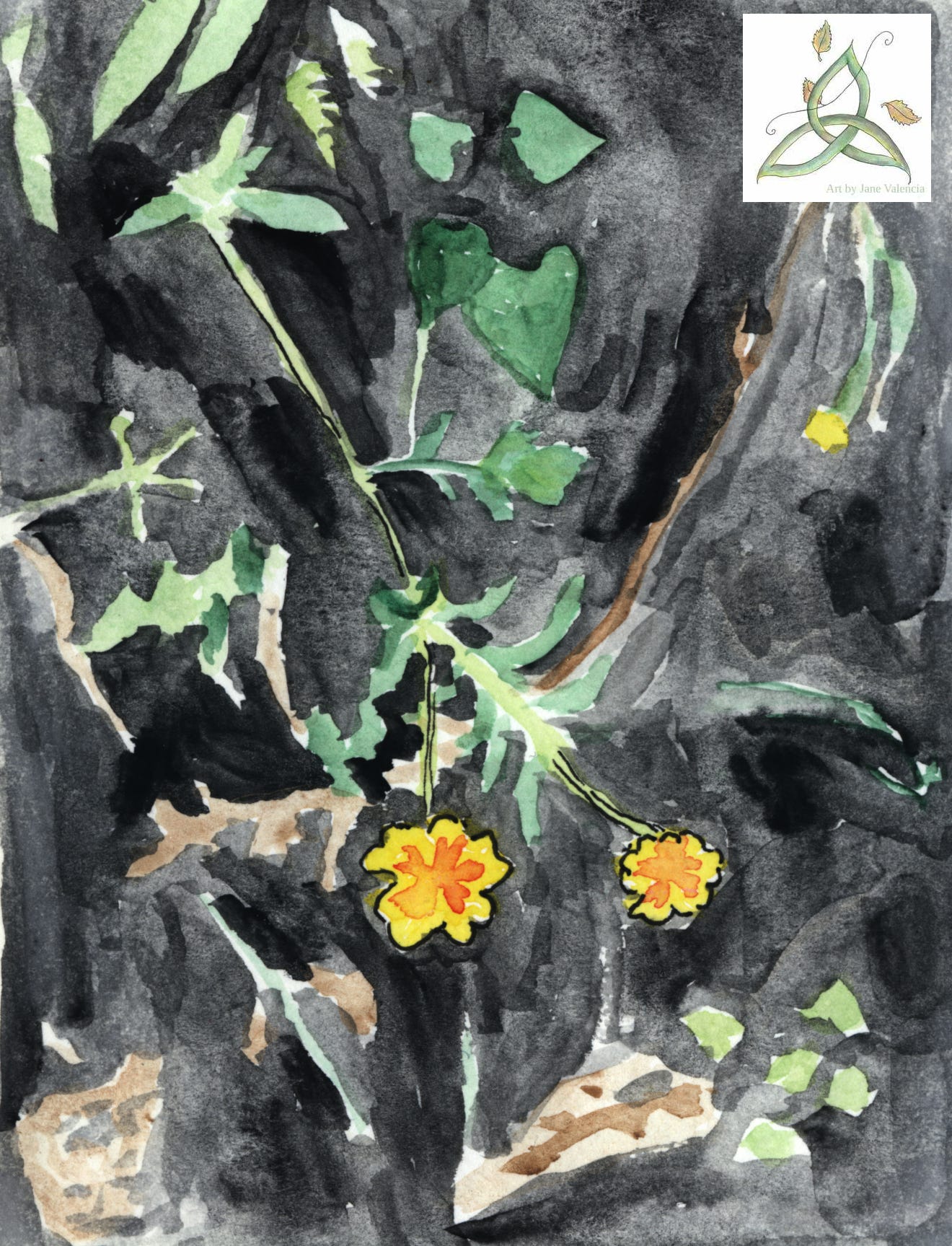
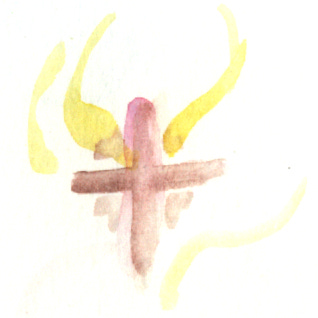
In the Cuauhtinchan Archeological Zone in Malinalco, we hiked up Cerro de los Idolos to the Aztec temple complex near the top. I was captivated by the flowers, trees, and butterflies along the way. The above illustration is an abstract rendition of the sunshine-bright Pericón flower. A medicinal and culinary plant, Pericón is bundled and woven into crosses that are put up above street-facing doorways on the Feast day of San Miguel Arcángel (Michaelmas, September 29), to ward off evil. I’ll make time to paint one of those San Miguel crosses, and post the illustration, and maybe write more about Pericón.
We saw several of those flower crosses as we drove through Malinalco.
Nuestra Virgen en La Casa de la Marquesa Hotel, Querétaro
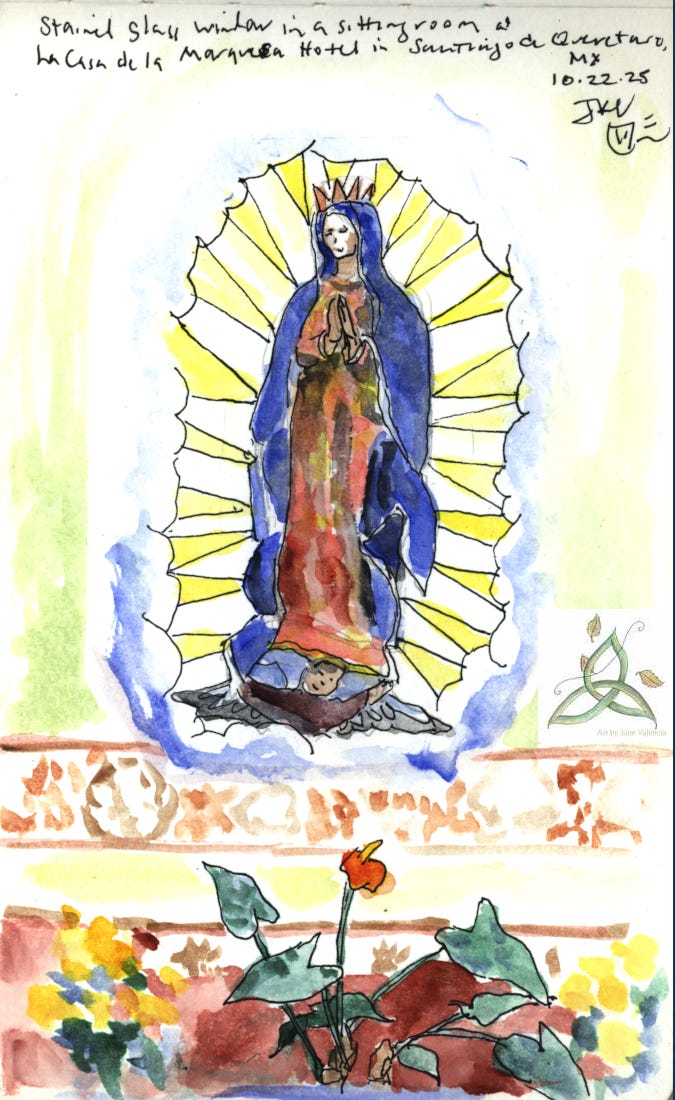
Another excursion took us to the historic center of Querétaro, UNESCO World Heritage Site. Erin and I stayed in a stunning historic hotel, which was originally a baroque-style home (small palace?) built in 1756. Lots of Moorish design and detail throughout.
In one sitting room was a stained glass window of Our Lady of Guadalupe. In the illustration above, I compressed the space and took liberties with a few details, so that I could include the beautiful plants and frescos on the notebook page.
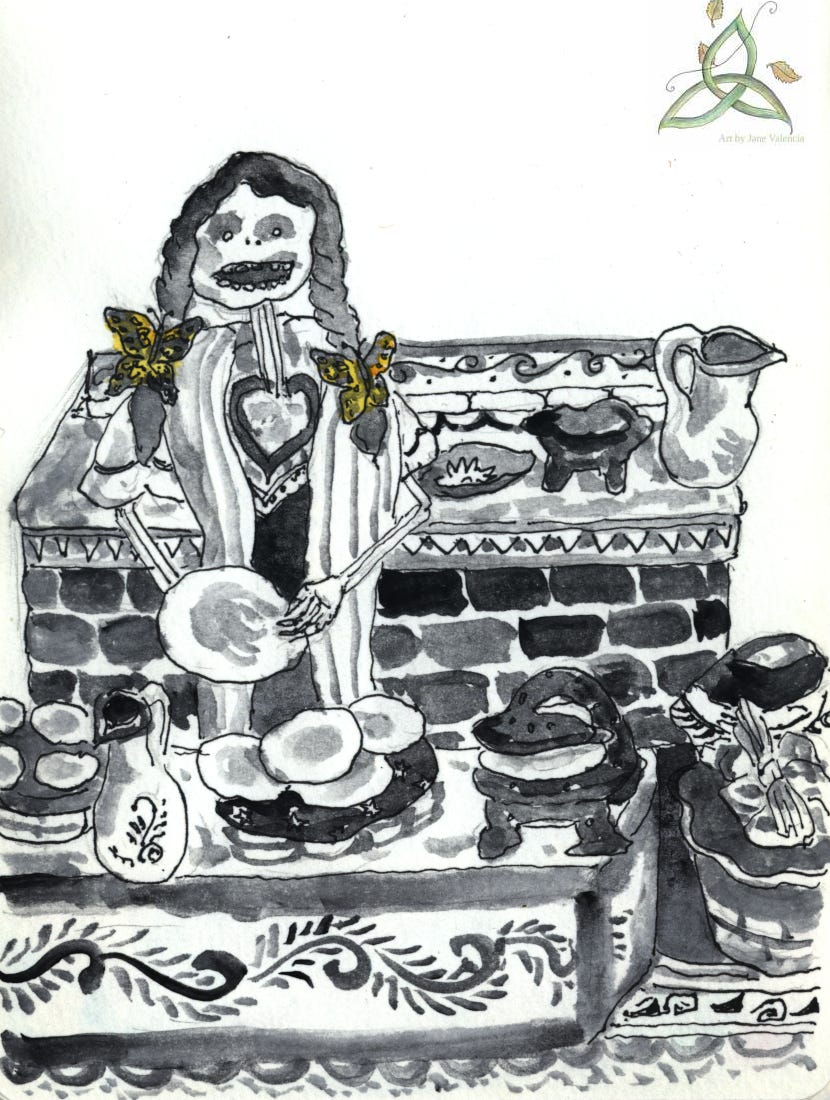
Catrina en la Cocina, Cuidad de Mexico
In Querétaro, Día de Muertos preparations slowly ramped up. By the time we returned to Mexico City, they were in full swing. Ofrendas (altars) were everywhere, including in shops. Most feature “catrinas” - charming (usually) dressed up skeletal figures. I took a photo of a table decoration in one of the stores (alas, I don’t recall the name of the store, and didn’t note the maker of the item). The following illustration is inspired by the table decoration, with a couple of altered details (the butterflies as braid ties, for one).
I hope you enjoyed these “postcards”! They don’t begin to convey all that I experienced. But … perhaps … I will draw some more, and share further!
Blessed All Souls Day to you all,